Wednesday, September 28, 2011

Lobstah Terms

A little behind on your lobster terminology? Here are some lobster terms used by real lobstermen!

Bug: Slang for lobster.

Cull: A lobster with only 1 claw.

Cock: A male lobster.

Hen: A female lobster.

Berries: Lobster eggs.

Berried Lobster: A hen with eggs under her tail.

V-tail: If a lobsterman catches a berried lobster, he must “v-notch” the lobster. By cutting a small
“v” on the lobster’s tail in the second flipper from the right, the hen safe from being caught for life. Any lobsterman who catches a notched lobster must throw her back even if she is not carrying eggs at the time. This ensures the safety of all procreating females.

Molt: When a lobster sheds its shell in order to grow larger into another shell.

Soft Shell or “Shedder”: A lobster who has recently molted and shed its shell to grow into a larger shell. Soft shell lobsters tend to be a little more inexpensive than hard shell lobsters because there is less meat, but this meat also tends to be sweeter and easier to access by hand.

Hard Shell:
A lobster who has fully hardened after molting. Hard shells provide more meat when eating, but are also harder to get into and require nutcrackers.

Cephalothoraxes: This is the name used to describe the fused segments of the head and thorax.

Carapace: The hard shell covering the cephalothoraxes.

Metal Gauge: This is the tool used to measure the lobster before catching. The gauge is placed at the eye socket of the lobster and measures the carapace of the lobster’s shell. If the lobster’s carapace does not fit between the jaws of the gauge, then the lobster must be thrown back.

Shorts: Lobsters who are too small to harvest.

Banding: When a lobster is deemed fit to catch, it must first be banded around its claws. This ensures safety when touching the lobsters, but also protects the lobster from harm to itself and others when in the live-tank.

Live-tank: This is a tank found on a lobster boat full of seawater to hold the day’s catch.

Tote: The box used to hold the bait placed in all traps. Totes can hold up to 200 pounds of bait.

Trap: A cage full of bait used to hold lobsters until they can be caught.

Buoy: A color specific marker used to indicate the placement and ownership of traps. (put in link to buoy blogs)

Gaff: This is a wooden pole with a hook on the end used to pull up buoys from the boat. Pulling up a buoy is called “gaffing”.

Hauler: This is an electronic device on the boat used to haul up traps from the ocean floor. Once the lobsterman has finished “gaffing” the buoy, he runs the buoy rope through the hauler which begins pulling the lobster traps towards the surface.

Sternman: The person responsible for emptying, baiting, and dropping traps after they have been hauled.

Washboard: The railing of the boat where hauled traps are placed to empty and re-bait.

Friday, September 16, 2011

Captain Dan’s Catch


When he’s not busy getting lobsters ready for Crate to Plate clients, Captain Dan is fishing around West Penobscot Bay’s many inlets and islands.

So where does he sell his daily catch? Besides his Crate to Plate traps and direct sales, most of Captain Dan’s lobsters are sold locally. This means that you can find Captain Dan’s lobsters in Lincolnville, Islesboro, and Rockland. You can also find Captain Dan’s lobsters at Natalie’s restaurant in the Camden Harbour Inn!

For more information on

Wednesday, September 7, 2011

The Crate to Plate Buoy


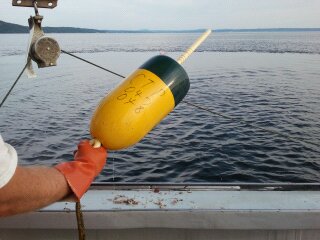
As explained in last week’s post on lobster buoys, every lobsterman uses color specific buoys to identify their traps. Captain Dan uses yellow buoys with a green stripe on top to identify his traps amongst the thousands placed in West Penobscot Bay.

Generally, Captain Dan delegates one buoy to mark two traps underwater. Each buoy is also numbered by the traps that they mark. These buoys range in size but are used to locate all 800 of the Captain’s traps. Crate to Plate accounts for 100 of these traps and are distinguished by a “CTP” written above the numbered traps they indicate. When pulling up Crate to Plate lobster traps, Captain Dan records the catch separately from his other traps.

Come see for yourself! Join Captain Dan on a fishing trip by contacting Crate to Plate today!

Wednesday, August 31, 2011

The Meaning of the Lobster Buoy


Lobster buoys serve as more than just decoration amongst Maine’s harbors and coastline and are in fact markers of lobster traps beneath the ocean surface. These buoys are a way for lobstermen to locate their traps and each follow a specific pattern. Every lobsterman has a specific color scheme for their buoy collection so that they may distinguish their traps from others.

Captain Dan’s buoy markers are painted yellow with a green strip on the top. These colors are used to identify all 800 of his traps, including the 100 traps used specifically for Crate to Plate.

Come see for yourself! Join Captain Dan on a fishing trip by contacting Crate to Plate today!

Wednesday, August 24, 2011

Crate to Plate's Local Catch

Want to know where your Crate to Plate lobsters come from?

Captain Dan and the Fisher Girl sail out of Saturday Cove in Northport, one of the many small inlets that make up West Penobscot Bay. Crate to Plate lobsters come from traps placed along the coast stretching from Lincolnville to Bayside. Coast dwellers may see the Fisher Girl near Islesboro’s ferry dock, at Lincolnville beach, or even as far north as Searsport.

While fishing, Captain Dan sails around many of the islands littering the Maine coast including Flat Island, Seal Island, and Ram Island— all bordering Islesboro’s shore.

Wednesday, August 17, 2011

Saturday Cove, Home of the Fisher Girl


Nestled between Little Harbor and Kellys Cove, Saturday Cove sits across from Seal Harbor and the beautiful island of Islesboro. Saturday Cove is one of the many small inlets and harbors that make up West Penobscot Bay. This small cove also offers the perfect port for Captain Dan and the Fisher Girl to lobster from and serves as a base for all of Crate to Plate lobster operations.

Wednesday, August 10, 2011

The Fisher Girl

Here is a picture of Captain Dan’s lobster boat the Fisher Girl. Captain Dan acquired his fishing boat in 1999 after beginning fishing in 1994. The boat is named after a picture the Captain saw of a girl enjoying a day on the beach.