Showing posts with label lobstering. Show all posts

Wednesday, December 21, 2011

The Lobster Family

We all know why Maine lobster is titled the True American Lobster, but what about their relatives in the south?

Warm water lobsters, also called spiny or rock lobsters, can be found in tropical waters near the Caribbean, the Mediterranean, Asia, or even the coast of Florida or Southern California. The
warm water lobster differs from the Maine lobster in that it does not have claws, but instead two large spiny antennae. The only edible meat on a warm water lobster is in its tail, which tends to be about 33% of its body weight!

Warm water lobster is the biggest food export in the Bahamas, and is the world’s source for frozen or canned lobster. Although similar in size and look, the warm water lobster and the Maine lobster are actually from a different class, and with over 40 species in the world this is
easy to believe!

Tuesday, October 4, 2011

Lobstah Facts!


Love lobster? Well we hope you enjoy these “lobstah” fun facts!

General information about our little red friend:

 The first recorded lobster catch was in 1605. That’s a long relationship that we have had with our red little friend!

 Before the lobster gained popularity in the mid-19th century it was considered a mark of poverty served to prisoners, servants, and widows. Servants even specified in employment agreements that they would not eat lobster more than twice a week!

 In 1828 Maine passed a law banning out-of-state lobster-men. So you can trust that your Maine lobster has been caught by a true Maine-ah!

 The largest Maine lobster catch weighed in at nearly 71 million pounds for a value of over $285 million. Now that’s a lot of lobstah!

 The largest recorded lobster was caught off of Nova Scotia weighing in at a crushing 44 lbs. and an astonishing 3 ½ feet length.

True life: lobster

 Depending on the temperature of the water (lobsters grow slower in colder waters), it takes a lobster 5-7 years to grow to maturity and a size that is catchable.

 Our little red friends stay with us for a long time—some are even capable of living up to 100 years!

 Lobsters naturally have one larger forward claw, causing them to be identified as left-handed or right-handed. The meat from the smaller claw is more tender and sweeter, thus considered more succulent.

 Lobsters can regenerate their antennae, legs, and even claws. Losing a claw is common as lobsters will frequently amputate them to escape any danger on the ocean floor.

 Lobsters grow by shedding their shell and developing into a new, larger shell--this process is called molting. The molting of lobsters is how we get our soft and hard shell lobsters. Lobsters that have recently shed their old shell in order to grow a new one are considered soft shell or “new shell”. The shell is much easier to get into and the lobster meat tends to be much sweeter than hard shell. A hard shell lobster has already grown into its shell. That is why these lobsters are so much harder to get into!

 A young lobster in its first 5-7 years will molt about 25 times a year while mature lobsters only molt about once or twice a year—usually in the summer. Older lobsters only need to molt once every 3-4 years.

 Want to know if a lobster is male or female? It’s easy! Located on the lobster’s tail are swimmerets-- small flipper like appendages that help the lobster swim. Look the first pair of swimmerets closest to the lobster’s head. If they are hard and bonelike your lobster is a male, but if soft and featherlike it is female!

 Lobster eggs spend at least ten months on a female lobster, the colder the water, the longer it takes the eggs to hatch!

 When the eggs are ready to hatch, the mother will shake them out of their shell, releasing them as larvae. The larvae will float to the surface for 4 to 6 weeks. This makes the larvae very vulnerable to attack by fish, birds, and other sea life. In fact, less than .1% of larvae survive this surface period before sinking to the ocean floor to develop.

Eating lobster:

 The best time of the year to enjoy lobster is after Labor Day! Lobstermen bring in over 50% of the annual Maine harvest during the fall season.

 Maine set a size limit of 3 ¼” for lobsters to allow all juveniles to mature and reproduce before they are harvested. Lobster lovers typically dine on 1 lb, 1 ¼, and 1 ½’ crustaceans!

 Lobsters are a fantastic “dieting” food because they are high in protein and
low in fat. Compare a 3 ½ ounce lobster of 90 calories (without butter of course) to the 163 calories found in the same amount of chicken or 280 calories in a sirloin steak. How could you go wrong?

 It is a common misconception that lobsters scream when they are boiled.
Don’t worry, the sound you are hearing is actually the whistling sound of steam escaping the shell. Eat on!

 Lobster meat will become tough if overcooked. To avoid this, check the lobster frequently. When the meat turns opaque it is done and should be immediately removed from heat.

 After you have boiled your lobster use a pair of kitchen shears to snip the claws. This will allow for the water to drain and keep your plate and other food from getting soggy!

 If you are having lobster for a formal occasion, pre-crack the lobster for your guests by cutting lengthwise through the underside of the tail with scissors (just the shell, not the meat). You can also crack the claws to save some pounding at the dinner table. Enjoy!

 Don’t miss out on the flavorful meat in the legs! To get this succulent meat you can either suck it out or use a rolling pin to roll down the sections of the legs and push the meat out of the end.

 Additional cooking of already boiled lobsters tends to toughen the meat and make it less palatable. So use your left over lobster meat for a salad or a cold dish.

Want to brush up on your lobster lingo? Check out our post on lobster terms used by real lobstermen!

Wednesday, September 28, 2011

Lobstah Terms

A little behind on your lobster terminology? Here are some lobster terms used by real lobstermen!

Bug: Slang for lobster.

Cull: A lobster with only 1 claw.

Cock: A male lobster.

Hen: A female lobster.

Berries: Lobster eggs.

Berried Lobster: A hen with eggs under her tail.

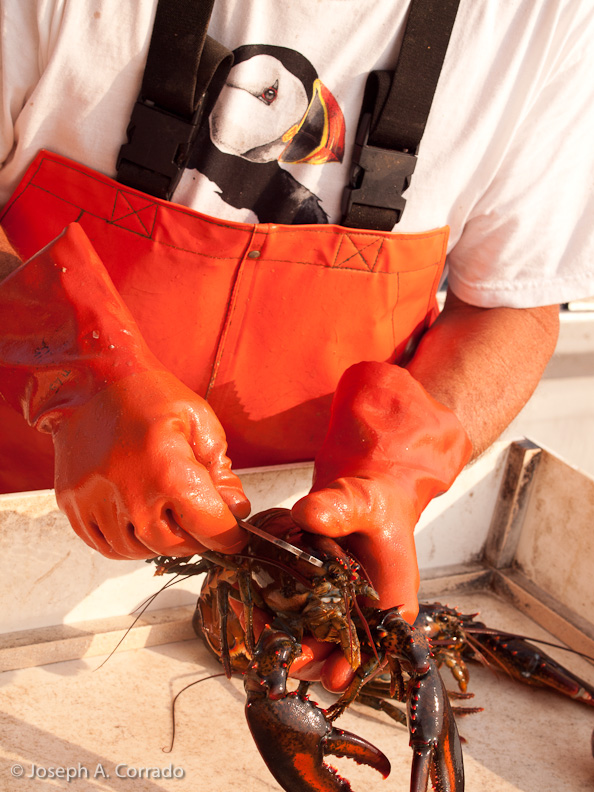
V-tail: If a lobsterman catches a berried lobster, he must “v-notch” the lobster. By cutting a small
“v” on the lobster’s tail in the second flipper from the right, the hen safe from being caught for life. Any lobsterman who catches a notched lobster must throw her back even if she is not carrying eggs at the time. This ensures the safety of all procreating females.

Molt: When a lobster sheds its shell in order to grow larger into another shell.

Soft Shell or “Shedder”: A lobster who has recently molted and shed its shell to grow into a larger shell. Soft shell lobsters tend to be a little more inexpensive than hard shell lobsters because there is less meat, but this meat also tends to be sweeter and easier to access by hand.

Hard Shell:
A lobster who has fully hardened after molting. Hard shells provide more meat when eating, but are also harder to get into and require nutcrackers.

Cephalothoraxes: This is the name used to describe the fused segments of the head and thorax.

Carapace: The hard shell covering the cephalothoraxes.

Metal Gauge: This is the tool used to measure the lobster before catching. The gauge is placed at the eye socket of the lobster and measures the carapace of the lobster’s shell. If the lobster’s carapace does not fit between the jaws of the gauge, then the lobster must be thrown back.

Shorts: Lobsters who are too small to harvest.

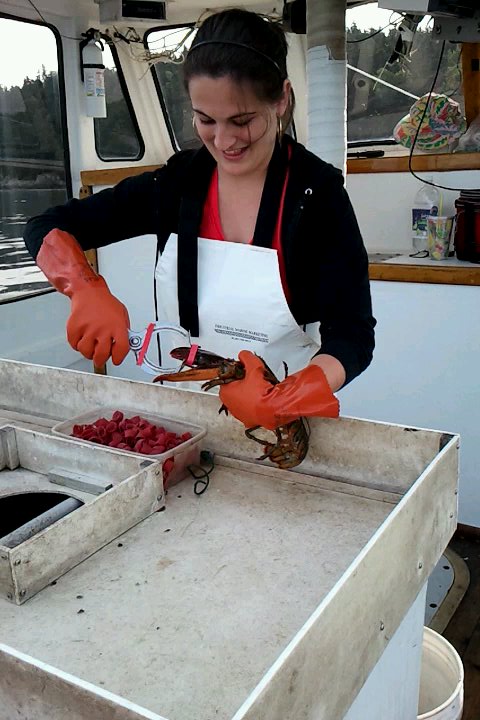
Banding: When a lobster is deemed fit to catch, it must first be banded around its claws. This ensures safety when touching the lobsters, but also protects the lobster from harm to itself and others when in the live-tank.

Live-tank: This is a tank found on a lobster boat full of seawater to hold the day’s catch.

Tote: The box used to hold the bait placed in all traps. Totes can hold up to 200 pounds of bait.

Trap: A cage full of bait used to hold lobsters until they can be caught.

Buoy: A color specific marker used to indicate the placement and ownership of traps. (put in link to buoy blogs)

Gaff: This is a wooden pole with a hook on the end used to pull up buoys from the boat. Pulling up a buoy is called “gaffing”.

Hauler: This is an electronic device on the boat used to haul up traps from the ocean floor. Once the lobsterman has finished “gaffing” the buoy, he runs the buoy rope through the hauler which begins pulling the lobster traps towards the surface.

Sternman: The person responsible for emptying, baiting, and dropping traps after they have been hauled.

Washboard: The railing of the boat where hauled traps are placed to empty and re-bait.

Wednesday, August 31, 2011

The Meaning of the Lobster Buoy


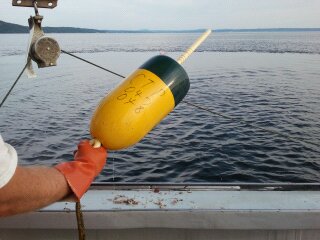
Lobster buoys serve as more than just decoration amongst Maine’s harbors and coastline and are in fact markers of lobster traps beneath the ocean surface. These buoys are a way for lobstermen to locate their traps and each follow a specific pattern. Every lobsterman has a specific color scheme for their buoy collection so that they may distinguish their traps from others.

Captain Dan’s buoy markers are painted yellow with a green strip on the top. These colors are used to identify all 800 of his traps, including the 100 traps used specifically for Crate to Plate.

Come see for yourself! Join Captain Dan on a fishing trip by contacting Crate to Plate today!

Wednesday, August 24, 2011

Crate to Plate's Local Catch

Want to know where your Crate to Plate lobsters come from?

Captain Dan and the Fisher Girl sail out of Saturday Cove in Northport, one of the many small inlets that make up West Penobscot Bay. Crate to Plate lobsters come from traps placed along the coast stretching from Lincolnville to Bayside. Coast dwellers may see the Fisher Girl near Islesboro’s ferry dock, at Lincolnville beach, or even as far north as Searsport.

While fishing, Captain Dan sails around many of the islands littering the Maine coast including Flat Island, Seal Island, and Ram Island— all bordering Islesboro’s shore.

Wednesday, August 17, 2011

Saturday Cove, Home of the Fisher Girl


Nestled between Little Harbor and Kellys Cove, Saturday Cove sits across from Seal Harbor and the beautiful island of Islesboro. Saturday Cove is one of the many small inlets and harbors that make up West Penobscot Bay. This small cove also offers the perfect port for Captain Dan and the Fisher Girl to lobster from and serves as a base for all of Crate to Plate lobster operations.

Wednesday, August 10, 2011

The Fisher Girl

Here is a picture of Captain Dan’s lobster boat the Fisher Girl. Captain Dan acquired his fishing boat in 1999 after beginning fishing in 1994. The boat is named after a picture the Captain saw of a girl enjoying a day on the beach.


Wednesday, August 3, 2011

Lobster Fishing with Crate to Plate


Want to fish with a real Maine lobsterman? Go sailing with Captain Dan on the Fisher Girl and learn the trade that has made Maine famous!

Sailors will live the true fishing experience as they navigate the rocky coast picking up traps. Watch eagles sunbathing on Flat Island while learning to haul traps and pack bait bags. Discover a harem of seals laying on a rocky key while emptying traps and banding lobsters.

Sailors will experience the beauty of ocean life while becoming an expert on all things “lobst-ah”. Learn how to correctly pick up a lobster, the difference between a hard and soft shell, or even how to “V-notch” a hen. Guests will practice the same environmentally conscious lobster procedures that have been a part of Maine life for over 100 years.

So join Crate to Plate and Captain Dan on a fishing adventure and discover Maine’s lobster in a whole new way!

For more information on how to schedule a tour with Captain Dan, please visit the Crate to Plate website.

Wednesday, July 27, 2011

Meet Captain Dan!


Crate to Plate may have begun in November 2009, but Captain Dan’s relationship with our lobster friend actually began in 1994.

A long time ocean lover, Captain Dan has been sailing since 1979. After graduating from college, Dan moved to Florida to start work in the corporate world. Six years later, Dan got his Captain’s license and began sailing around the world delivering and servicing yachts.

On a routine sail to deliver a boat, Captain Dan ended in up in Maine. Upon seeing the state’s beauty and possibilities, he decided to stay in Vacationland to discover the Midcoast’s rocky beaches, island speckled coast line, and its most famous export—lobster.

Deciding it was time for a career change; Captain Dan embraced his new state’s specialty and began lobster fishing in 1994. A self-taught fisherman, Captain Dan steadily grew his business to include over 800 traps located around the Northport coast.

Today Crate to Plate offers customers a full lobster experience including boat tours for those who would like to learn Captain Dan’s famous trade or the harvest of one of his many traps. Check out the Crate to Plate site for more information on Captain Dan and his lobster friends!

Wednesday, September 22, 2010

Lobstering with Captain Dan


We have had an unbelievable summer. The weather has been consistently sunny and in the 80’s since May. It’s been so good we didn’t have our normal fifth season, mud, this year. Whether it has been the long hot days, the calm seas or a secret of Mother Nature our catch has been very good. We normally throw back as many as we keep. Not this year; for the most part there were consistent catches of 5 – 6 lobsters in each trap, most averaging 1 ¼ to 1 ½ lbs per lobster. Now we did see a brief slow down with the approach of hurricanes Earl and Igor. But the threats were more than the impact and the lobsters are returning.

It is important to note at Crate to Plate your catch is lobsters not pounds. A half season harvest of 20 – 30 lobsters is 30 to 45 pounds. That is a party. So come see us. Fall may be upon us, but it is still a great time to put on your boots, roll up your sleeves and join Captain Dan on the Fisher Girl. There is nothing like the first hand experience of hauling up a trap. Come see how lobster are caught and more importantly sustained.

Image by Annie Higbee of imagewright, on behalf of Meandering Maine.

Thursday, August 12, 2010

Lobster in Maine is Great!


You may have heard a lot of negative press out of Massachusetts regarding this year’s catch but that is in Massachusetts. Maine harvests 80% of the annual lobster harvest and not because we are lucky or that Maine is a better habitat for lobster. It is because Maine lobstermen have for generations fished with an eye to the future. They never keep below weight, female with eggs or over large species because canny frugal Mainers know that what isn’t protected today won’t be available tomorrow. Lobstering is not sport it is a way of life that father’s have taught sons (and now daughters) since the first settlement. For many it is the desired livelihood of the future. To ensure that future every fisherman on the water in Maine is a conservationist.