Wednesday, November 30, 2011


Already excited for next summer’s lobster season? Start planning for these upcoming lobster events!

The 11th Annual Maine Lobster Ride & Roll

When: July 21, 2012

Where: Oceanside High School

Join bikers as they trek around Maine’s beautiful coastline. Participate in one of four distances, and don’t forget to grab your fresh lobster roll for lunch!

The 65th Annual Maine Lobster Festival

When: Wednesday, August 1st, 2012-Sunday, August 5th, 2012

Where: Rockland Maine’s Harbor Park

Join thousands of lobster lovers in a celebration of our little red friend! Watch the crowning of the Maine Sea Goddess or the annual Lobster Festival Parade. Shop local arts and crafts while listening to live entertainment. And don’t forget to dig in to the 20,000 pounds of fresh Maine lobster!!

For other lobster related events for the upcoming year, click here.

Tuesday, November 15, 2011

The Beauty of Bait


Here is a picture of the bait used to lure lobsters into the Crate to Plate traps. The bait used by Captain Dan can be anything from Herring to Rock Fish or Red fish to Hoagies. Every trap is filled with a bag of bait and then replaced with new bait after it has been hauled.

The tote that you see in this picture holds about 200 lbs. of bait. Captain Dan and his crew go through 6 or 7 totes of bait on each fishing excursion. That’s around 1000 lbs. a day!

Want to join Captain Dan and the Fisher Girl for a sail? Contact Crate to Plate to plan your own fishing adventure!

Tuesday, November 8, 2011

Pick Up a Live Lobster (And Live to Tell the Tale)

Want to pick up your live lobster? Here’s how!

Very quickly place one hand around the sides of the lobster’s middle, right below the claws. With the other hand, push the lobster’s claws from the bottom so that they are straight against its head. Re-adjust your grip so that you are holding both claws and the body. With its claws against its head the lobster can no long move to grip or pinch.

The lobster may start flapping its tail or thrashing after our first touch, just be aware of the claws and make sure to move quickly. Now that you are ready, pick up some Crate to Plate lobsters today!

Tuesday, November 1, 2011

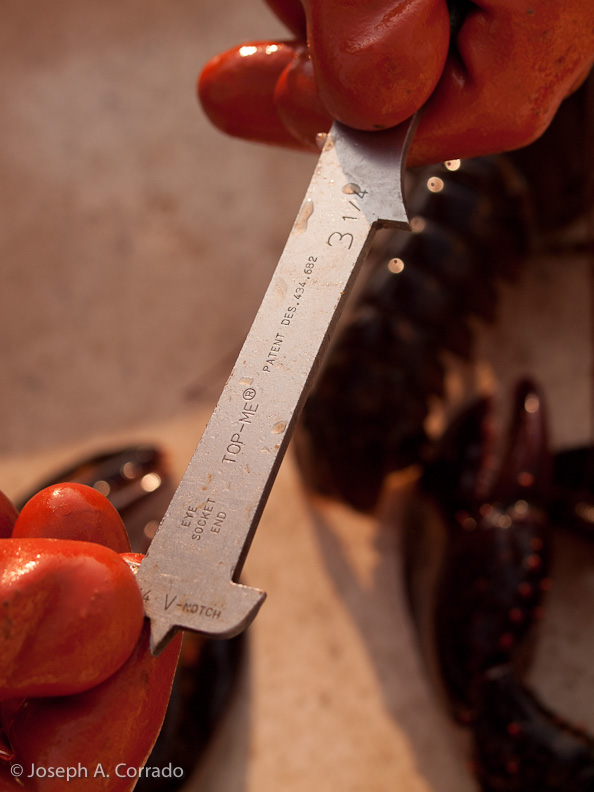
What Size is Your Lobster?


Maine lobstermen have been harvesting lobster in the same environmentally conscious way for over 100 years. These practices include “V-notching” female lobsters as well as setting a size limit for harvested lobsters.

Maine’s lobster size limit is 3 ¼ lbs. so as to allow all juveniles time to mature and reproduce before they are harvested. Every lobster caught is measured to ensure the survival of our favorite red friend.

Lobsters are measured based on the size of their carapace, the hard shell segment between the tail and the head. Lobstermen place a metal gauge at the lobster’s eye socket down the carapace. If the lobster’s carapace does not fit between the jaws of the gauge, then the lobster must be thrown back.

Lobsters can also be too small to be caught as well. Lobsters too small to harvest are called shorts. Lobster lovers in Maine typically dine on 1, 1 ¼, and 1 ½ lb. crustaceans!

Tuesday, October 25, 2011

Preserving Our Favorite Red Friend

In our previous post on sexing lobsters, we mentioned that female meat is considered sweeter, but it turns out that it is also rarer to find on our dinner table. Here’s why!

In order to preserve the lobster population, Maine lobstermen have adopted environmentally friendly fishing practices spanning back over 100 years. These regulations require that all reproducing females must be returned to the ocean after being caught.

In order to ensure that these reproducing lobsters remain safe, Maine lobstermen use what is called “V-notching” to mark the females. If a lobsterman catches a berried lobster (a female lobster with eggs under her tail), they must cut a small “v” on the lobster’s tail on the second flipper from the right. By V-notching this female, the lobster is forever safe from being caught. Any lobsterman who catches a notched lobster must throw her back even if she is not carrying eggs at the time. This practice ensures the continuation of our favorite lobster friend!

Want to brush up on your lobster lingo? Check out our post on lobster terms used by real lobstermen!

Tuesday, October 18, 2011

What Gender is Your Lobster?

What to know if your lobster dinner is male or female? Here’s how!

To find the sex of your lobster, check the underbelly of the lobster’s tail. Located on along the backside of the tail are swimmerets—small flipper like appendages that help lobsters swim, reproduce, as well as provide a place for a female to carry her eggs. These swimmerets will vary depending on lobster sex.

To sex your lobster, look to the first set of swimmerets closest to the lobster’s head. If the swimmerets are hard and bonelike your lobster is a male, but if they are soft and featherlike you have a female! Male swimmerets also tend to be wider than their female counterparts. Many claim that female meat is said to be sweeter, so happy hunting!

Tuesday, October 11, 2011

How Do Lobsters Grow?

As we learned in last week’s Lobster Facts, lobsters grow larger by shedding their shell. This process of molting depends on water temperature as well as lobster age and size.

Lobsters molt by secreting enzymes that soften their current shell. Once they are hidden from harm, a molting lobster will split the back of its shell and fold its body into a V in order to back out of its current home. Shedding lobsters are very vulnerable at this stage because their shell is very soft as it grows into its new body. An average molt will increase a lobster’s size by 20%.

As lobsters grow, their molting becomes less frequent. The smaller the lobster the more it sheds. Even lobster larvae (eggs recently detached from the mother-see link) molt within their egg. It is said that larvae will molt about six times within the egg and then many more times at the ocean surface before sinking to the sea floor. In the first 3 years, a lobster will molt at least every other month slowing to twice a year by years 5-7. After year 7 (when the lobster is considered to have reached maturity), the lobster will only molt once a year. Eventually as the lobster grows, molting will only take place once every few years depending on how long it takes to grow into the new shells.

Lobsters molt in cycles typically based on water temperature. Warmer waters aid in lobster growth, and many times molting becomes seasonal as the water temperature rises and falls. Adolescent lobsters will many times molt in the summer as temperatures rise, and again in the fall as the temperatures drop.

Want to brush up on your lobster lingo? Check out our post on lobster terms used by real lobstermen!